
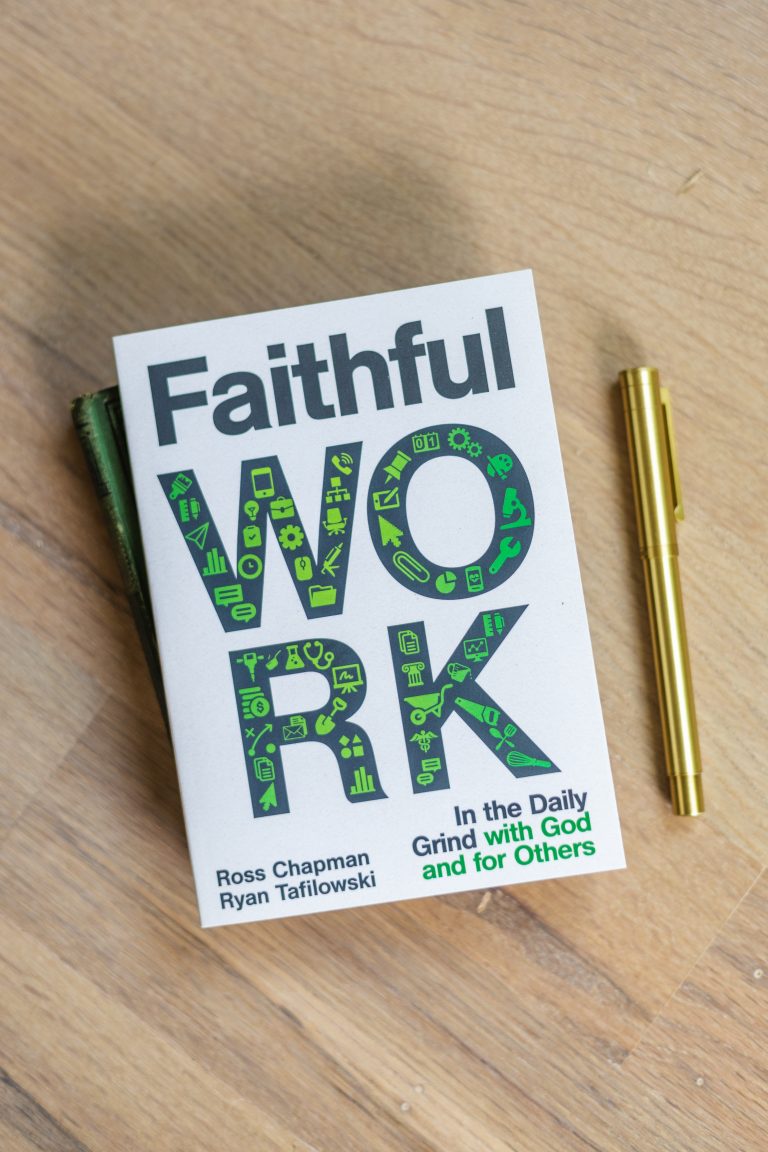
By Ross Chapman and Ryan Tafilowski (IVP, 2024)
Book Summary by Ross Chapman
“Why did they send a pamphlet instead of a book?” asked one of my mentors when he finally received Faithful Work in the mail.
While it stung for a second, it was exactly the response we wanted. We set out to write something concise, accessible, and finishable, for all types of Christian workers. Why? Because we are convinced that if Christians fail to understand and embody God’s vision for daily work, then the good news of God’s Kingdom will remain truncated, and the Church’s public witness will stay thin.
Our society lacks a compelling vision for work, and how can we blame it? Work is often exhausting, anxiety-producing, and spiritually disconnected. According to Gallup’s annual report, two-thirds of workers are disengaged on the job. In the Church, work is often viewed as little more than a platform for evangelism or a way to fund actual ministry.
Faithful Work offers a theologically rich and pastoral invitation to reimagine daily work as essential to God’s work in us and in the world. Whether you’re a business leader, pastor, nonprofit practitioner, educator, student, or parent, your invitation is to be faithfully present in the daily grind, right where God has you, working with him, for the good of others and the renewal of all things.
The book is structured around some of the key theological and cultural questions the Church must ask to work faithfully in every sector and role. We explore:
- Why does our work matter?
- How does God see it?
- What do we do when our work feels fruitless, consuming, or meaningless?
- What is calling, really—and how do we discern it in a world obsessed with self-actualization and individual choice?
- How do we work faithfully in a polarized, pluralistic culture without compromise or retreat?
- And what does real rest look like in an overworked and restless society?
There is nothing formulaic about doing faithful work. Every job and context is unique. So, we hope to offer a clear framework for renewed imagination that is rooted in five key relationships: with God, self, others, systems and structures, and creation. Each chapter is accessible but theologically substantive as we interweave Scripture, cultural critique, and practical reflection.
For example, in the final chapter we reframe rest not only as mere cessation or escape but as participation in God’s own rest. Rest is a state of being grounded in our union with Christ himself and in his finished work. It’s a vital counterbalance to our performance-driven work culture.
It was a joy to co-author this project with Dr. Ryan Tafilowski, Chair of the Theology Department at Denver Seminary, who has helped shape and guide Denver Institute’s curriculum for years. We hope Faithful Work reads like a field guide: brief and practical but theologically grounded. It’s a book (pamphlet!) for individuals, groups, and book clubs and a primer for college students preparing for the workforce.


